

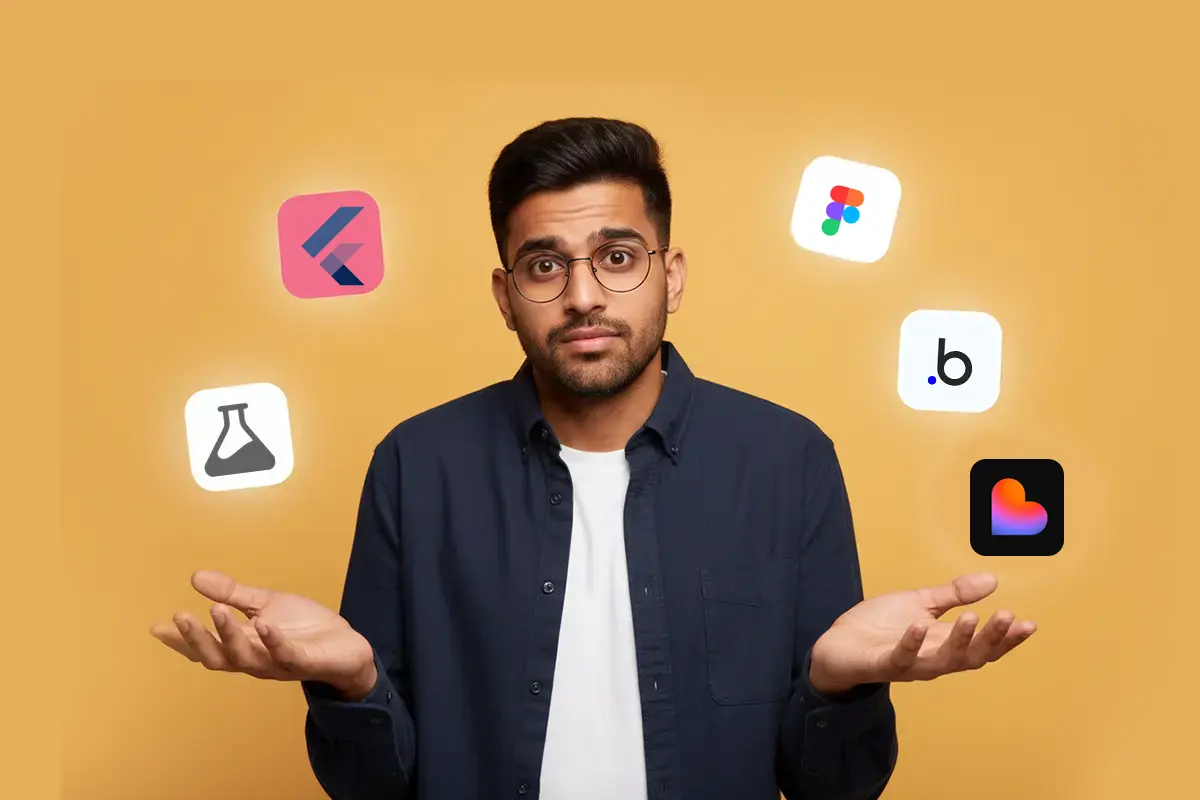
No code UI UX tools are rapidly changing how digital products are designed and built. Platforms like Figma Make, Google Stitch, Flutter, Bubble.io, and Lovable promise speed and accessibility. But do they replace designers or empower them? This blog explores the real impact of no code tools on the future of design and why adaptability matters more than fear.
Introduction
The rise of no code UI UX tools has sparked a familiar debate in the design community. Are these tools democratizing design or slowly replacing professional designers? With platforms like Figma Make, Google Stitch, Flutter, Bubble.io, and Lovable gaining traction, the boundaries between design and development are becoming increasingly blurred.
Rather than asking whether these tools will replace designers, a better question is how they are reshaping the role of design itself.
Why No Code Tools Are Gaining Momentum
Product teams are under constant pressure to move faster. No code platforms reduce the time between idea and execution by allowing interfaces and flows to be created with minimal engineering effort.
These tools also lower the barrier to entry. Founders, marketers, and product managers can now prototype and ship functional experiences without deep technical skills. In an era of rapid experimentation, speed often outweighs perfection.
Beyond Software Access
Once software moved to the cloud, infrastructure followed. Infrastructure as a Service allowed companies to rent compute, storage, and networking on demand. Platform as a Service abstracted even more complexity, enabling developers to focus on building products instead of managing systems.
These layers formed the foundation for a broader service based mindset.
The Impact of Leading Platforms
Figma Make is extending design into execution by enabling designers to generate interactive and responsive components directly from design intent. This shortens feedback loops and keeps designers closer to the final product.
Google Stitch focuses on rapid UI generation and consistency, leveraging AI to help teams create cohesive interfaces aligned with modern design standards. It reflects Googles push toward design automation at scale.
Flutter bridges design and development by offering a unified framework for building cross platform interfaces. Designers who understand Flutter gain influence over how designs translate into real products.
Bubble.io empowers non developers to build complex applications visually. It has become a popular choice for startups validating ideas quickly without heavy engineering investment.
Lovable represents a new generation of AI driven creation tools that focus on translating intent into usable interfaces. These platforms emphasize collaboration between humans and machines rather than manual execution.
Are Designers Being Replaced
The fear of replacement often arises when tools automate execution. However, execution has never been the true value of design. Tools can assemble layouts, but they cannot understand user psychology, business context, or long term product vision.
Design decisions still require research, empathy, prioritization, and trade offs. No code tools accelerate output, but they do not replace thinking.
The Opportunity for Modern Designers
Designers who embrace no code tools gain leverage. They can prototype faster, test ideas earlier, and collaborate more effectively with engineers and stakeholders.
Understanding how designs behave in real environments allows designers to create more practical and scalable solutions. This shifts the role from visual creator to product thinker and system designer.
Engenia’s Perspective
No code UI UX tools are not the end of design. They are the next evolution of it. Platforms like Figma Make, Google Stitch, Flutter, Bubble.io, and Lovable are changing how work gets done, but human insight remains irreplaceable. The goal is not to replace designers but to elevate them into roles that shape product strategy and experience at scale.
If your design team is navigating the shift toward no code tools, Engenia can help you redefine roles, workflows, and systems that turn speed into sustainable impact. Let us build the future of design together.


