

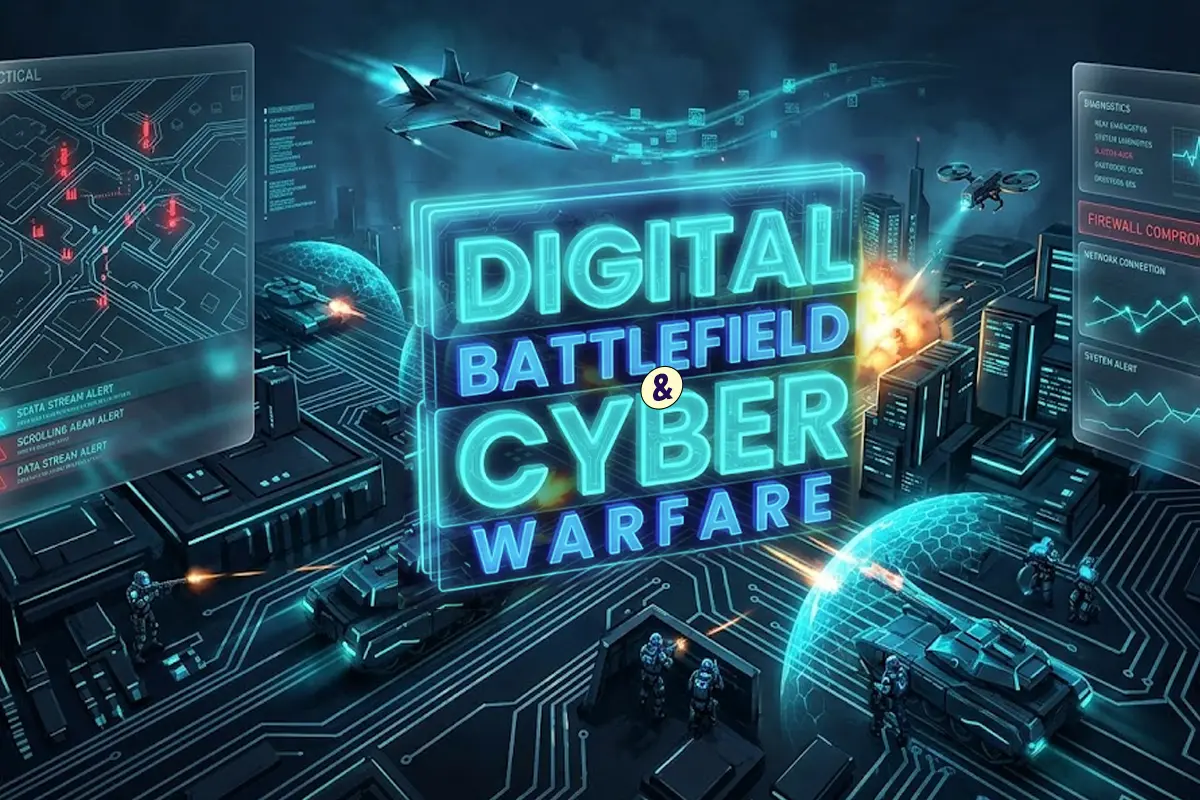
The frontline of modern warfare now runs directly through your enterprise servers. From compromised traffic networks in Tehran to retaliatory strikes on healthcare giants, the digital battlefield spares no one. Learn how the new age era of AI driven cyber warfare demands unprecedented corporate governance and discover how to secure your critical infrastructure today.
Introduction: The Digital Prelude to Conflict
Many conflicts today begin long before the first missile is fired or soldiers cross international borders. Cyber operations have officially become the first theater of conflict. In this new age era, cyber warfare is a fully operational domain shaping global power dynamics, evidenced by the United States Department of War setting a 13.5 billion dollar budget for cyber activities.
What began as stealthy acts of cyber espionage has evolved into continuous operations that blend intelligence gathering, disruption, and psychological manipulation, creating a multi layered battlefield where digital actions actively magnify physical and political outcomes.
The Cyber Physical Frontline: The Middle East Analogy
Recent geopolitical tensions brilliantly illustrate this shift towards a digital prelude to kinetic warfare. During the ongoing tensions and conflicts involving Iran, the United States, and Israel, intelligence services reportedly compromised Tehran’s traffic camera network. By accessing these video feeds for years, intelligence agencies built detailed pattern of life profiles and analyzed movement in strategically sensitive areas.
Conversely, this cyber physical conflict flows both ways; a pro Iranian hacker group recently attacked the United States medical technology giant Stryker in direct retaliation for the ongoing war in Iran. These events prove that modern warfare integrates cyber capabilities with physical actions seamlessly, redefining the battlefield before any conventional engagement occurs.
AI and the Scale of Mass Surveillance
Artificial intelligence fundamentally reshapes this battlefield by removing traditional human constraints. Previously, the limits of human analysts and linguists naturally disciplined the scope of surveillance and military targeting. Today, AI systems can process massive datasets across multiple dialects simultaneously, integrate historical and real time information, and generate targeting recommendations at an unprecedented scale, as seen with military initiatives like Project Maven.
The limiting factor is no longer human expertise but computing power, expanding the set of potential targets and drastically compressing the time available for review.
Civilian Infrastructure as Strategic Intelligence
The rapid digitization of urban infrastructure has expanded the attack surface drastically. Systems once intended solely for civilian use, such as smart city sensors, transportation networks, energy grids, and healthcare facilities, are now primary targets in cyber warfare.
Attackers routinely exploit vulnerabilities in outdated firmware or default settings to gain remote access, turning everyday technology into powerful tools for intelligence gathering and operational disruption. The integration of AI driven tools allows malicious actors to automate vulnerability scanning and launch highly sophisticated supply chain attacks that infiltrate multiple organizations simultaneously.
The Corporate Battleground and Governance Tensions
This reality creates unique challenges for enterprise governance, as private companies are increasingly caught in the crossfire of national security. For example, the frontier AI company Anthropic recently clashed with the Pentagon by refusing to allow its software to power autonomous weapons or mass surveillance, leading the government to label the firm a supply chain risk. This dispute highlights a growing tension in the new age era: should private firms embed binding safety constraints at the model level, or must those limits yield when national security is invoked?
As AI systems become more deeply integrated into global networks, organizations face profound questions regarding the boundary between decision support and automated decision making.
The Geopolitical Divide and Legal Asymmetry
As these digital threats evolve, international legal frameworks remain drastically underdeveloped, lacking universally accepted definitions or robust enforcement mechanisms. This ambiguity creates a profound geopolitical asymmetry. In the United States, companies can legally resist or place specific conditions on participating in defense activities, as seen in recent corporate clashes over AI governance.
Conversely, in nations like China, commercial tech firms are legally required to support state intelligence and military objectives, ensuring the rapid integration of commercial capabilities with fewer institutional barriers. This legal divide forces democratic enterprise leaders to navigate complex ethical boundaries while striving to remain globally competitive.
Building Resilience in a Multipolar Threat Landscape
To navigate these complex threats, organizations must recognize that cybersecurity is no longer merely an IT concern; it is a matter of economic and national survival. Defending against state sponsored proxy groups, organized cybercriminal syndicates, and automated AI attacks requires a proactive posture.
Enterprises must implement zero trust architectures, continuous vulnerability management, network segmentation, and stringent third party vendor assessments to protect their interconnected ecosystems.
Engenia’s Perspective
We understand that operating in the new age era requires treating digital infrastructure as strategic infrastructure. The convergence of cyber and physical threats means that traditional security perimeters are obsolete. We advocate for a holistic, secure by design approach where intelligent threat detection and rigorous governance are built directly into the foundation of your enterprise platforms. Protecting your data is no longer just about standard compliance; it is about ensuring unwavering operational resilience in a highly volatile, multipolar threat landscape.
The digital domain is a strategic battlespace capable of determining outcomes long before conventional forces are deployed. Enterprises and governments alike can no longer afford to treat civilian infrastructure as off limits to adversaries. The competitive advantage now belongs to those who actively fortify their digital networks today, before the next international conflict escalates in cyberspace.
Disclaimer: The views expressed in this article are those of the author and do not necessarily reflect the views of the publication.


