

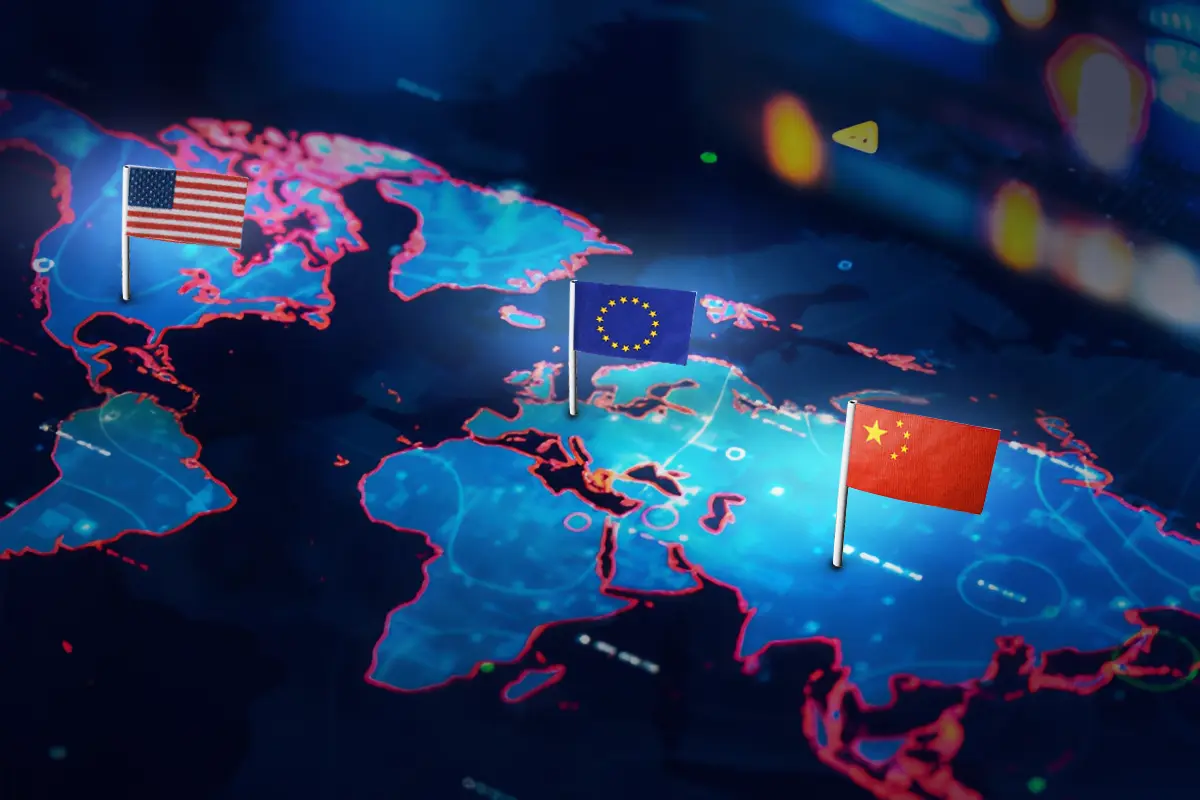
The global technology stack is entering a new phase. Software leadership remains centered in the United States, hardware dominance continues across Asia, and artificial intelligence is becoming a borderless global layer. This blog explores how this new global stack is forming, why it matters in 2026, and how businesses must adapt to a more distributed technology reality.
Introduction
The global technology landscape is reorganizing itself. In 2026, the idea of a single country dominating the full technology stack no longer holds. Instead, a new global model is emerging. Software innovation is led primarily by the United States. Hardware manufacturing and optimization are anchored across Asia. Artificial intelligence operates as a global layer that transcends borders.
This new global stack is redefining how products are built, scaled, and governed.
The Software Layer Remains US Led
The United States continues to dominate software platforms, cloud services, and digital ecosystems. Enterprise software, developer tools, operating platforms, and consumer applications are still largely designed and orchestrated by US based companies.
This leadership is driven by strong venture ecosystems, mature cloud infrastructure, and a culture of rapid product iteration. The software layer sets the rules of engagement for how data flows, how APIs interact, and how businesses monetize digital services.
In 2026, software is less about ownership and more about orchestration. Control comes from platforms rather than products.
Asian Hardware as the Physical Backbone
While software defines logic, hardware defines reality. Asia remains the manufacturing and optimization engine of the global stack. Countries such as Taiwan, South Korea, China, and Japan dominate semiconductor fabrication, memory production, and device assembly.
Advanced chips, sensors, memory modules, and consumer devices continue to rely on Asian supply chains. Even as nations attempt to localize manufacturing, the scale, expertise, and efficiency of Asian hardware ecosystems remain unmatched.
Hardware is no longer a commodity. It is a strategic asset tied to geopolitics, supply resilience, and economic power.
AI as a Global Layer Without Borders
Artificial intelligence introduces a new dimension. Unlike software platforms or physical hardware, AI models and intelligence layers are globally distributed. Training may happen in one region, deployment in another, and optimization across many.
AI research is collaborative by nature. Talent, data, and innovation flow across borders despite regulatory constraints. Open models, shared frameworks, and global research communities ensure that AI does not belong to a single geography.
In 2026, AI becomes the connective tissue of the global stack. It amplifies the value of both software and hardware regardless of origin.
Why This Stack Is Emerging Now
Several forces are driving this shift. Supply chain disruptions exposed the risks of over concentration. AI workloads increased dependence on specialized hardware. Cloud platforms abstracted infrastructure complexity. Geopolitical tensions encouraged diversification rather than isolation.
The result is a modular global stack where each region specializes in what it does best.
Implications for Businesses
Organizations can no longer think locally when building technology systems. Software choices must consider global compliance. Hardware dependencies require supply chain visibility. AI strategies must account for data sovereignty and cross border execution.
Competitive advantage will come from integration rather than control. Companies that can orchestrate software, hardware, and AI across regions will move faster and adapt better.
Technology leadership now requires global thinking. Architecture decisions are strategic. Vendor relationships carry geopolitical weight. Talent strategy must span regions.
The winners of 2026 will be those who design systems that assume global interdependence rather than resist it.
Engenia’s Perspective
At Engenia, we view the new global stack as an opportunity to design resilient and future ready systems. We help organizations align software strategy, hardware dependencies, and AI capabilities into coherent global architectures that scale responsibly.
The new global stack of 2026 reflects a more interconnected and specialized world. US software sets the logic, Asian hardware provides the foundation, and global AI delivers intelligence. Success lies in how well organizations navigate and integrate this reality.
If your organization is building products or platforms for a globally distributed future, Engenia can help you design technology strategies that balance innovation, resilience, and scale.


