

Generating software is no longer the bottleneck. As artificial intelligence drastically accelerates coding, the true competitive advantage lies in orchestration. Discover why complex system design, agentic workflows, and high level developer judgment are the essential human leverage systems required for enterprise survival and lasting operational resilience.
The End of the Builder Era and the Rise of the Conductor
A few years ago, the enterprise world worshipped the builders, those individuals who could code fast, design iteratively, and ship products on incredibly tight deadlines. However, that specific era is rapidly ending. Today, artificial intelligence can write, design, build, and deploy complex software in a fraction of the time, never tiring and never missing a deadline. Speed is now essentially free and completely accessible to everyone; any team with a few good prompts can deploy a functional minimum viable product in a single afternoon. Because of this, the primary bottleneck in the new age era is no longer the actual building process. Instead, the greatest challenge is deciding what is actually worth making in the first place and how those new creations fit seamlessly into existing ecosystems.
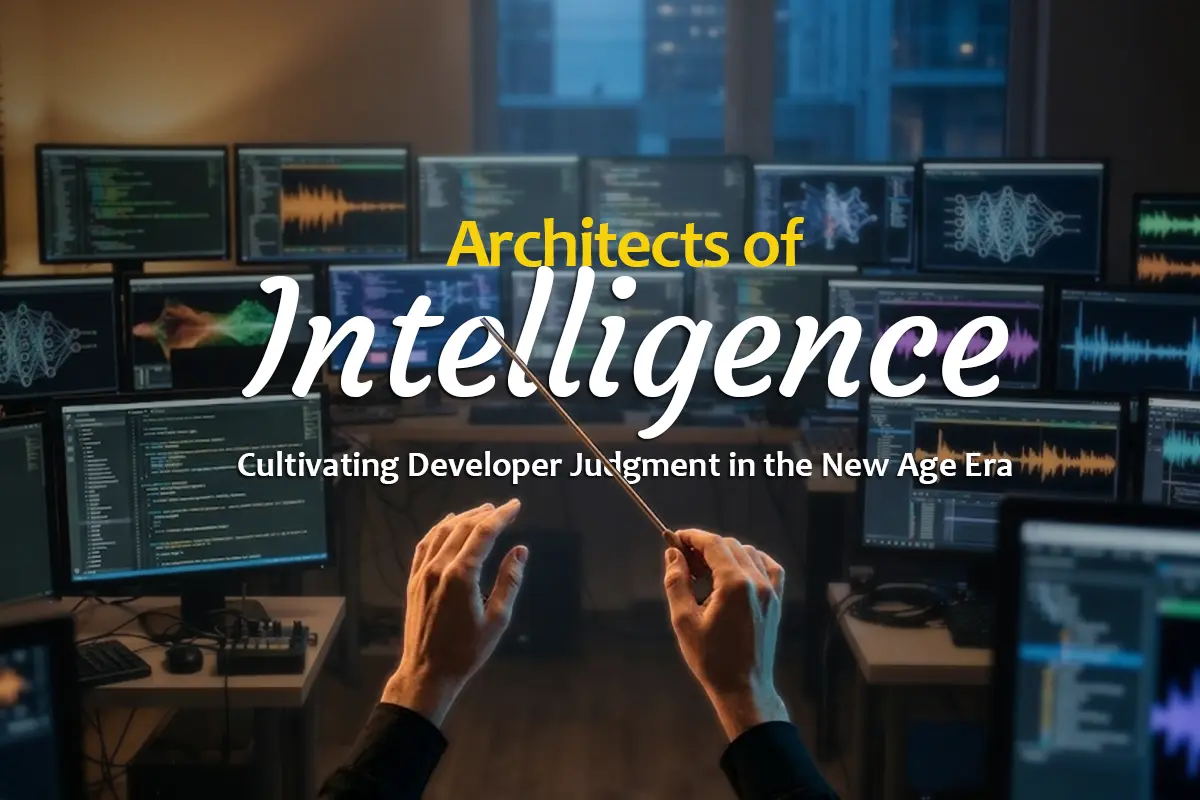
To understand this massive shift, you must think of a modern technology startup or enterprise as a massive orchestra. You have dozens of powerful instruments, including coding agents, design models, research copilots, and automation tools, and each plays its part perfectly. But without a highly skilled conductor, the end result is just chaotic noise. Orchestration is the profound ability to make all these disparate tools work together toward a coherent, valuable outcome. It requires transitioning from being a mere typist to acting as a strategic conductor, shifting the professional focus from junior level code generation to senior level systems creation.
This fundamental productivity shift elevates professionals who can seamlessly bridge the gap between human intent and artificial intelligence execution, essentially turning them into the true architects of automated businesses.
The Core Mechanics of Agentic Orchestration
Mastering orchestration requires far more than basic surface level prompting; it demands a deep understanding of grammar, logic, and system composition. It is exactly what allows you to create profound meaning out of a dozen different tools working simultaneously. In practice, this means mastering agentic AI orchestration, which is the ability to strategically link different artificial intelligence models together to create autonomous, end to end workflows. This involves sophisticated prompt chaining, where sequences of precise instructions are designed to connect reasoning steps together logically.
It also requires meticulous workflow design to map exactly how vital information flows between various tools, application programming interfaces, and generative models. For example, if you were building a highly personalized news application, you could theoretically vibe code the entire project over a single weekend. However, to truly scale it for demanding enterprise use, an orchestrator must step in. They would meticulously design a robust data pipeline pulling from multiple feeds, utilize prompt chains to score and filter relevance, connect everything seamlessly to a user profile system, and implement continuous feedback loops so the underlying model improves over time. Every single one of those individual steps can be generated by an artificial intelligence, but deciding exactly how they connect is a complex task entirely left to human ingenuity.
The successful orchestrator views the entire overarching system as a continuous conversation between isolated models, vast data, and human intent, focusing heavily on structural integrity and system reasoning rather than sheer execution speed.
The Imperative of High Level Developer Judgment
As writing code becomes progressively easier and faster every single month, the true value of a development team has shifted entirely toward high level judgment. Artificial intelligence will happily build exactly what you ask for, even if what you asked for does not actually solve the underlying business problem. Therefore, the developers who will truly thrive in the new age era are those who choose to guide the artificial intelligence rather than fight it. They will spend significantly less time typing code and drastically more time thinking through complex logic, overarching constraints, and obscure edge cases. Deeply understanding the core problem and seeing how one isolated decision affects the entire software system is now the most critical component of engineering.
Furthermore, this judgment involves knowing exactly when the output of an artificial intelligence is good enough for production and, more importantly, recognizing when it is quietly wrong. This high level developer judgment means knowing when not to use artificial intelligence at all, rigorously auditing outputs for quality, and identifying which specific ideas possess the clarity of thought required to be worth pursuing. Organizations ultimately fail not because their AI tools are inadequate, but because they drown in artificial intelligence noise and mistakenly automate the wrong processes.
True relevance is maintained by learning to think at a higher architectural level, ensuring that the software does better rather than simply doing more, and making absolutely certain it works flawlessly when real users finally touch it.
Building the Enterprise with AI Native Architects
The technological transformation occurring right now closely mirrors the massive historical shift in software when the industry moved from managing physical servers to adopting highly scalable cloud computing. We are moving rapidly from manual coding to the sophisticated orchestration of intelligence. In this new age era, the most valuable founders and enterprise leaders are not the best coders or the fastest designers; they are the AI native individuals who deeply understand immense technological leverage. They know that building is no longer about pushing more lines of code into a repository, but about connecting automated intelligence in the precise order needed to generate massive business value. In practical terms, these architects think entirely in layers. They constantly ask themselves what specific business outcome they are optimizing for, which subproblems the artificial intelligence can handle autonomously, where critical human oversight is strictly mandatory, and how to seamlessly connect everything into one continuous operational flow.
This highly strategic mindset scales infinitely better than simply demanding more features from an exhausted development team. To cultivate this vital skill within an organization, teams must begin by building and thoroughly testing small multi agent systems, observing closely how outputs change when the workflow is exceptionally well designed. By continually questioning if the right sequence was defined and where human judgment fits into the loop, professionals move significantly closer to thinking like true orchestrators. The wildly successful enterprise of the future will not be a massive collection of traditional engineers, but rather a highly connected network of elite orchestrators.
Engenia’s Perspective
We recognize that the future belongs entirely to the architects of intelligence. Relying on artificial intelligence execution without robust orchestration is a guaranteed recipe for unmanageable technical debt and strategic failure. Enterprises must cultivate human leverage systems where engineers operate as conductors, enforcing strict governance, deep logical reasoning, and flawless curation.
By embracing high level developer judgment and focusing on comprehensive system design, organizations can safely harness the unprecedented velocity of the new age era while maintaining absolute security and operational resilience.
he competitive advantage of tomorrow lies not in how much software you can generate, but in how effectively you can orchestrate and curate intelligent systems. Are you ready to transition your team from typing to true architectural orchestration? Contact our strategic technology team today to discover how to implement secure, highly efficient agentic workflows within your enterprise.
Disclaimer: The views expressed in this article are those of the author and do not necessarily reflect the views of the publication.


